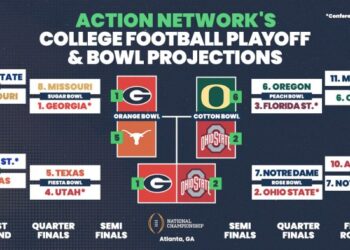

Delving into Bowl Projections and Betting Odds: Finding Value in Early Season Matchups, this introduction immerses readers in a unique and compelling narrative, with a casual formal language style that is both engaging and thought-provoking from the very first sentence.
Exploring the world of college football bowl projections and betting odds opens up a realm of excitement and strategy that impacts teams, fans, and bettors alike. Let’s unravel the intricacies of early season matchups and how they shape the future outcomes of these thrilling games.
Bowl Projections
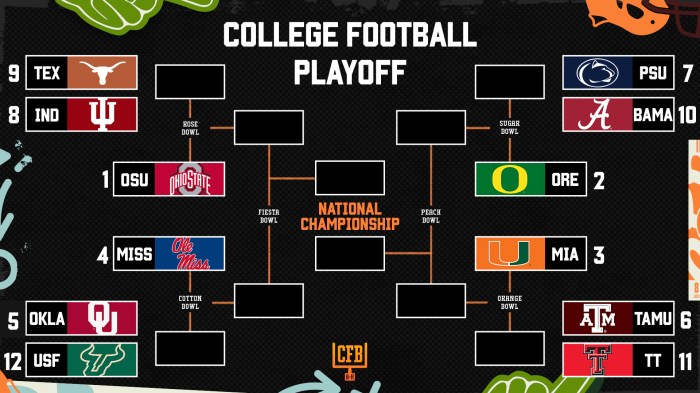
Bowl projections in college football are predictions made by analysts and experts about which teams will play in which bowl games at the end of the season. These projections are based on a variety of factors including team performance, conference affiliations, rankings, and historical bowl selections.
Early season bowl projections are often more speculative and based on preseason expectations, while end-of-season outcomes are more accurate as teams’ performances become clearer. As the season progresses, projections are updated to reflect teams’ actual records and rankings.
Bowl projections are important for teams as they provide goals to strive for throughout the season, for fans as they anticipate potential matchups and travel plans, and for bettors looking to place strategic wagers on future bowl outcomes.
Factors Influencing Bowl Projections
Bowl projections are influenced by various factors such as teams’ records, rankings, conference tie-ins, and head-to-head matchups. Analysts also consider factors like fan travel potential, team popularity, and previous bowl history when making projections.
Early Season Projections vs. End-of-Season Outcomes
Early season projections are often based on preseason rankings, returning players, and coaching changes, leading to more uncertainty. End-of-season outcomes are more accurate as they are based on actual team performances and final rankings.
Importance of Bowl Projections
Bowl projections are important for teams as they can impact recruiting, fan engagement, and program prestige. Fans use projections to plan potential bowl game trips and anticipate exciting matchups. Bettors use projections to identify potential value in betting lines and make informed wagers.
Betting Odds
Betting odds are numerical representations of the likelihood of a specific outcome in a sports event. They indicate the potential return on investment if that outcome occurs. These odds are calculated by sportsbooks based on various factors such as team performance, player injuries, historical data, and public perception.
Types of Betting Odds
- American Odds: Represented with a plus (+) or minus (-) sign, American odds show how much profit you would make on a $100 bet (+) or the amount you need to bet to win $100 (-). For example, if a team has odds of +200, you would win $200 on a $100 bet.
- Decimal Odds: Common in Europe and Australia, decimal odds represent the total return on a winning bet, including the initial stake. For instance, odds of 3.00 mean you would get $3 for every $1 wagered.
- Fractional Odds: Widely used in the UK, fractional odds show the potential profit relative to the stake. For example, odds of 5/1 mean you would win $5 for every $1 bet if successful.
Importance of Analyzing Betting Odds
Understanding and analyzing betting odds is crucial for making informed decisions in sports betting. By interpreting odds accurately, bettors can assess the implied probability of a team winning and identify value bets. Value bets occur when the probability of an outcome is higher than what the odds suggest, offering an opportunity for profitable betting.
Finding Value in Early Season Matchups
Early season matchups present a unique opportunity for bettors to find value in their wagers. As teams are still adjusting and finding their rhythm, there is often more variability in outcomes, creating potential for profitable bets.
Key Factors to Consider
- Strength of Schedule: Assess the quality of opponents faced by each team early in the season.
- Injuries and Suspensions: Stay updated on key player absences that could impact the outcome of the game.
- Coaching Changes: Consider how new coaching staff may influence team performance early on.
- Historical Performance: Look at past matchups between the teams to gauge potential outcomes.
Strategies for Evaluation
- Line Movement Analysis: Monitor how betting lines shift leading up to the game to identify value.
- Public Perception: Consider going against the public consensus if you believe the value lies elsewhere.
- Statistical Analysis: Dive into advanced stats like efficiency metrics to uncover hidden value in early season games.
Leveraging Early Season Matchups
- Look for Overreactions: Capitalize on overreactions to early season results by identifying undervalued teams.
- Focus on Under-the-Radar Teams: Explore matchups involving lesser-known teams that may provide better value opportunities.
- Trust Your Research: Utilize in-depth analysis and research to make informed decisions rather than relying solely on gut feelings.
Concluding Remarks
As we conclude our journey through Bowl Projections and Betting Odds: Finding Value in Early Season Matchups, we leave you with a deeper understanding of the dynamics at play in the world of college football. By recognizing the significance of early season matchups and the insights gained from analyzing betting odds, one can truly find value in every game.
Frequently Asked Questions
What factors influence bowl projections?
Bowl projections in college football are influenced by a team’s performance, strength of schedule, conference tie-ins, and overall record.
How are betting odds calculated in sports betting?
Betting odds are calculated based on various factors such as team performance, injuries, weather conditions, and public perception.
Why is it important to understand and analyze betting odds?
Understanding and analyzing betting odds is crucial for making informed decisions when placing bets, as it provides insights into the likelihood of a team winning.